Ionic Insights: The Business Jet Fleet in Canada
This, the latest in our series of aircraft market analyses, focusses on the installed business jet fleet in Canada. We assess the size, composition and age of the installed fleet, whilst simultaneously investigating the most popular OEMs, aircraft types and management companies.
Background
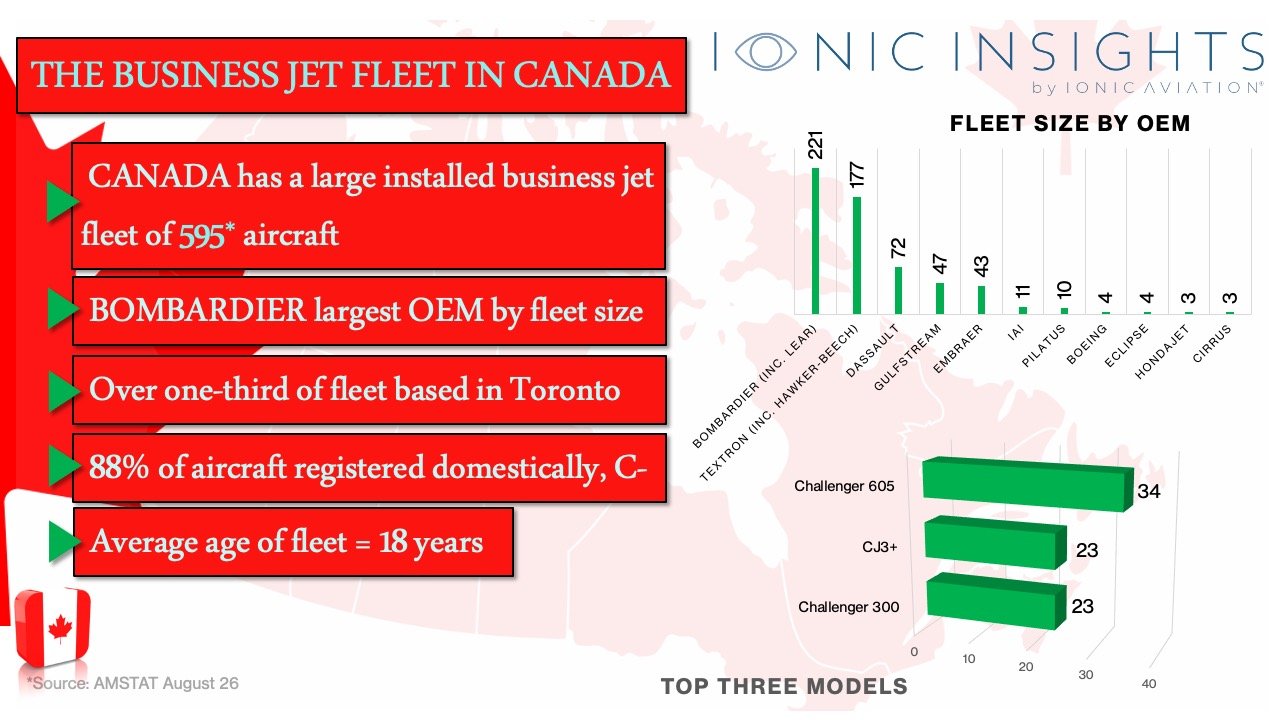
With a fast-growing population of over 40 million and an economy worth in the region of $2.5 trillion U.S. dollars, Canada is home to a large installed business jet fleet of 595 aircraft*.
The country’s economy is dominated by services, resources (oil, natural gas, timber, agricultural land and critical minerals), manufacturing (including aerospace) and technology. Deeply integrated with that of the United States, American consumers buy significant quantities of Canadian energy, vehicles (including aircraft), metals, agricultural products and manufactured goods.
The Installed Fleet
With 595 aircraft, Canada’s fleet is approximately 20% larger than that of Europe’s largest market, Germany. This is largely down to need. The sheer size and geography of the Canada and its neighbour the United States, combined with patchy domestic airline connectivity to the country’s more remote regions and cities, has led to the enthusiastic adoption of business jet aircraft by companies and individuals alike.
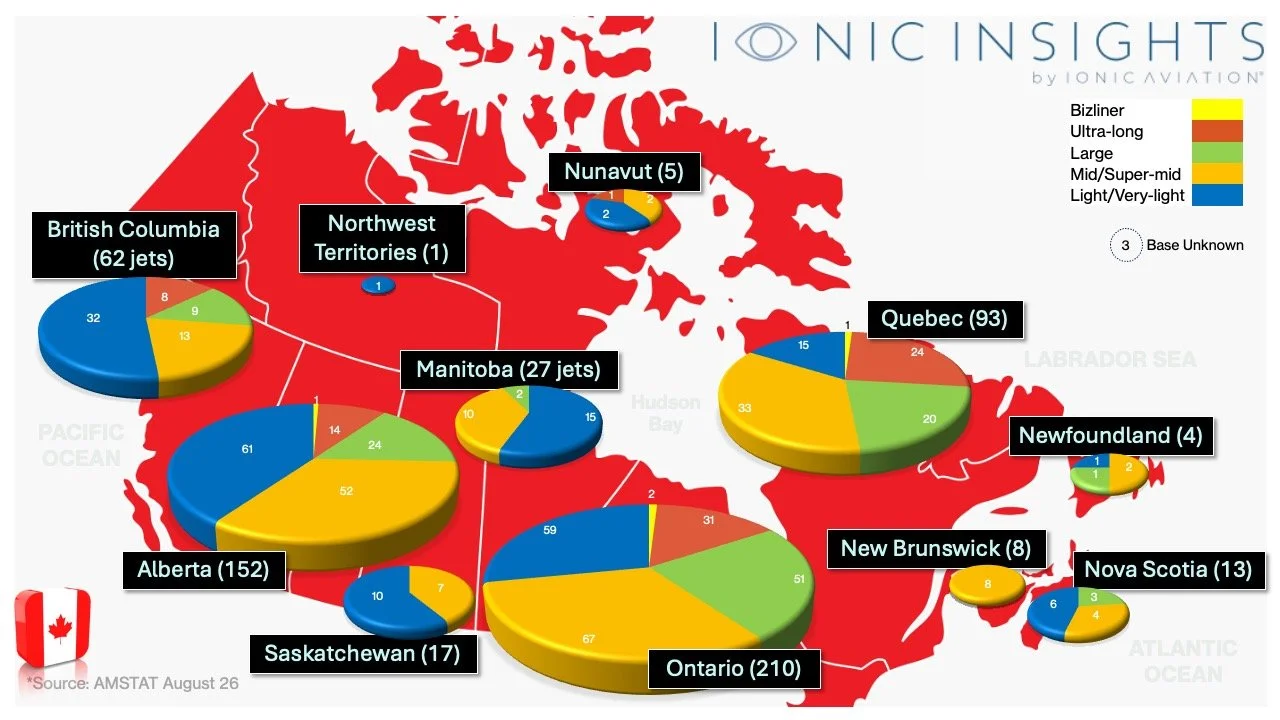
Domestic champion Bombardier boasts the largest overall fleet, whilst Textron (including Hawker-Beechcraft) comes in second. The most numerous models are the Challenger 605, Cessna CJ3+ and Challenger 300. Overall, the Light/Very light and Midsize/Super-midsize categories dominate, each being responsible for approximately one third of the overall fleet.
The largest aircraft management companies are Skyservice, Execaire and Chartright. Approximately ninety percent of all aircraft are registered domestically (C-), whilst the average age of the fleet is eighteen years.
Market Outlook
The outlook for the Canadian business aviation sector is overall very positive; utilisation and fractional activity are up, and there is continued strong demand for all types, particularly older and now out-of-production models (see the most popular models above).
Risks include fuel price volatility and high labour, maintenance and infrastructure costs. Whilst proximity and integration with the United States economy has contributed greatly to Canada’s prosperity, it has also created an inherent vulnerability. Trade tensions continue — first quarter growth was significantly hampered by U.S. tariffs and the resultant, and as not yet resolved, uncertainty. Bombardier is also significantly exposed to the U.S. market.
Irrespective of this, growth rebounded sharply in the second quarter and the outlook for the remainder of 2026 looks positive.
*Source: AMSTAT, August 2026.