Welcome to the latest edition of Ionic Insights!
In this edition we focus on the installed business jet fleet in South East Asia. We investigate the size, location and composition of the fleet, along with the most popular OEMs, aircraft types, registries and management companies.
The Fleet
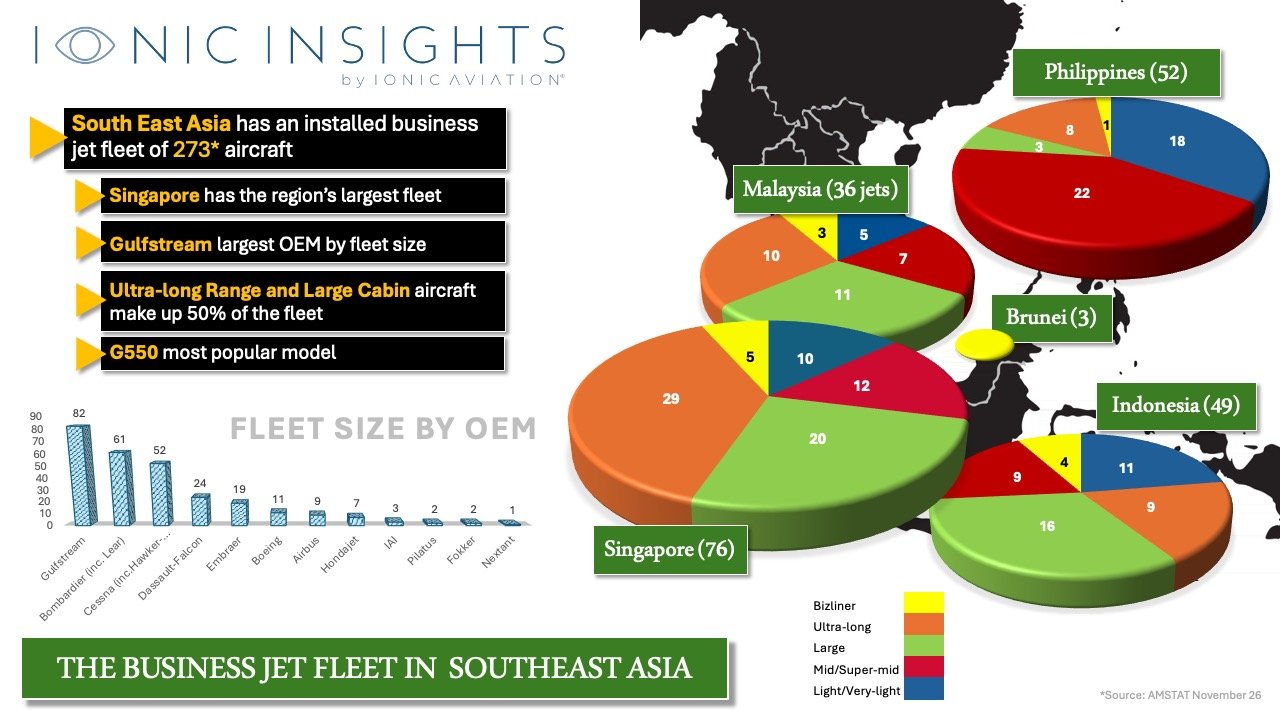
South East Asia has an installed business jet fleet of 273* aircraft.
Still considered an emerging market, the region has considerable growth potential given its overall economic size, population, wealth and geographic scale.
The distribution of the fleet is by no means uniform.
*Source: AMSTAT, November 2026.
Singapore, with its fleet of 76 aircraft, is the established regional hub. The city state boasts a concentration of wealth and multinational businesses whilst benefiting from world-class aviation infrastructure and expertise centred on Seletar Airport (ICAO: WSSL), which serves as a major base its own aircraft and also those owned elsewhere in the region, including neighbouring Malaysia.
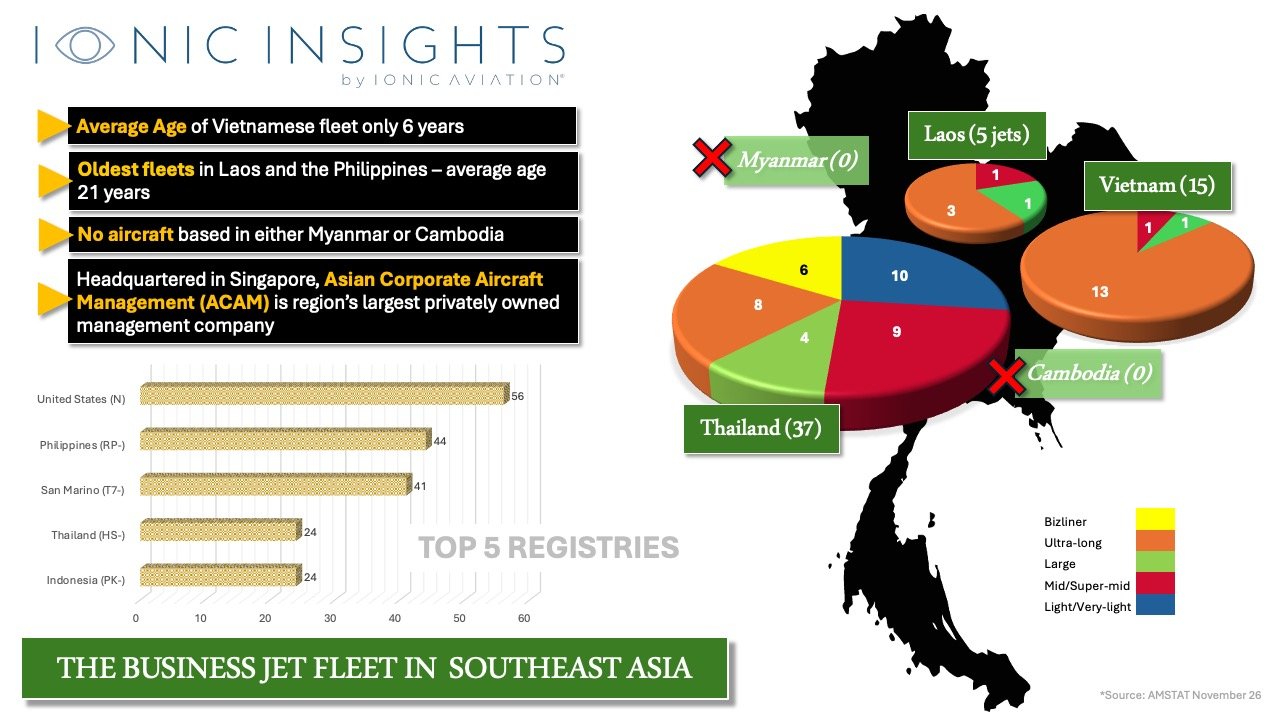
Conversely, Laos (5 aircraft) and Brunei (3) both have very small fleets, whilst there are no business jets based in either Cambodia or Myanmar.
Business jet usage in the Philippines (52 aircraft) and Indonesia (49) is largely driven by demand for domestic inter-island connectivity – Indonesia alone has more than 17,000 islands – and limited scheduled airline networks. Conversely, Thailand’s fleet (37) is largely centred around tourism, corporate usage and charter.
The most interesting market is Vietnam (with 15 aircraft). Albeit still small, its young business jet fleet grew from 9 to 15 aircraft in the year 2024/25 alone – a 67% increase. This growth was driven by significant corporate demand for large cabin aircraft capable of operating on long international routes. Unlike any other market, ultra-long-range aircraft now make up 87% of the fleet.
Across the region, large cabin and ultra-long-range aircraft make up 50% of the overall fleet. Gulfstream is the most popular OEM, with its G550 and G650ER aircraft being the most numerous models.
The three most popular registries in the region are the United States (N), Philippines (RP-) and San Marino (T7-).
*Source: AMSTAT, November 2026.
Market Potential
Whilst the potential across the region is significant, considerable obstacles to growth remain. These include:
· Regulatory fragmentation (each country having its own aircraft registration, operating permit, customs, taxation and aviation regulations means operating across borders can be complicated)
· Infrastructure limitations (airport slots, parking, hangars, maintenance facilities and dedicated business aviation terminals are concentrated in a handful of major cities)
· Limited professional expertise (the region needs more pilots, engineers, operations’ staff and general aviation specialists); and
· High operating costs (the cost of fuel, insurance, maintenance, crew, and the increasing costs of financing make aircraft ownership expensive).